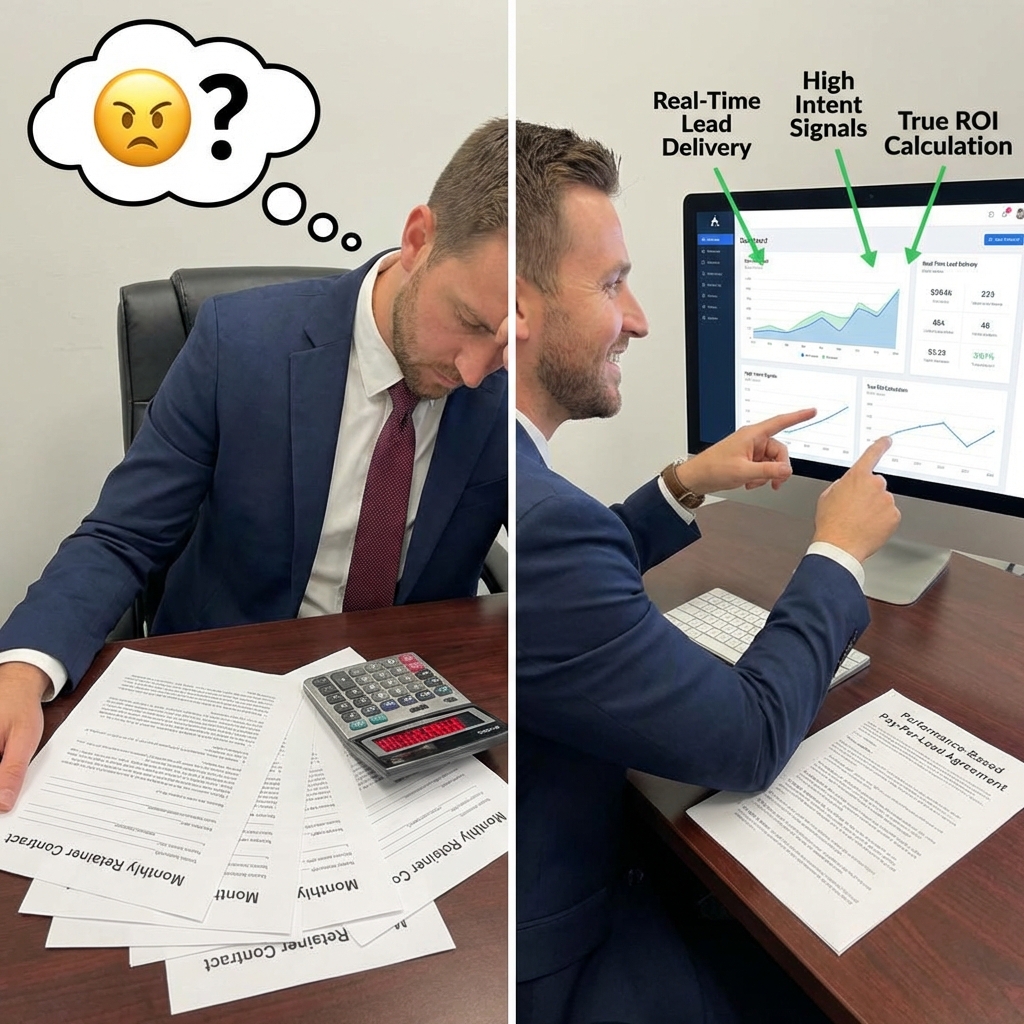
The Hidden Cost of Traditional Lead Generation Methods
Real estate investing thrives on a simple equation: quality leads in, profitable deals out. Yet many seasoned professionals find themselves trapped in an expensive cycle where they pay thousands monthly for leads that rarely convert, creating overhead that eats directly into profit margins. We built LeadGeeks to break that cycle by shifting the financial risk entirely onto the quality of our leads, not onto your budget.
Our performance-based model means you pay only when you get a lead that matches your criteria. No monthly commitments. No setup fees. No paying for contacts that don’t convert. For investors and agents with three or more years of experience, this approach eliminates the acquisition cost guesswork and puts control back in your hands.
Most lead generation platforms operate on a simple revenue model: they charge you upfront, whether the leads pan out or not. The costs are visible on your invoice each month. What’s harder to see is the cumulative damage to your bottom line.
Consider a typical investor working with a traditional lead provider. You’re paying a monthly retainer between $500 and $2,000 depending on the provider and your market. Over 12 months, that’s $6,000 to $24,000 in fixed costs. Now add the human cost: your team spends time following up on leads that don’t match your acquisition criteria, contacting sellers who aren’t motivated, and managing poor data quality. That’s opportunity cost layered on top of direct spend.
The real problem emerges when you calculate your true cost per acquisition. Let’s say you close one deal from 100 leads received. Your acquisition cost per deal could easily exceed $6,000 to $24,000 before you factor in the labor spent filtering through irrelevant contacts. Traditional providers don’t feel the pain when their leads underperform because the revenue model doesn’t depend on your success.
We see this situation repeatedly among the experienced investors who come to us. They’ve been locked into long-term contracts, sometimes paying for leads they never contacted because the quality was too low. That’s capital tied up in something that didn’t move the needle on your business. Your takeaway: evaluate any lead source by asking whether you’re paying for volume or for outcomes. The distinction matters more than you think.
Why Monthly Retainers Drain Your Acquisition Budget
Monthly retainer models create a financial anchor that doesn’t adjust with your business cycles. A slow month still costs full price. A month where you’re running three simultaneous deals and need fewer new leads still carries the same monthly fee. This inflexibility is especially painful for investors scaling their operations or adjusting to market conditions.
Let’s walk through a realistic scenario. You’re an experienced investor covering three counties. January is busy with closings, so new leads feel less urgent, yet you’re still paying $1,500 that month for leads you barely use. In March, you have bandwidth and you’re hungry for deals, but your monthly retainer hasn’t increased and suddenly you’re competing with other investors for the same lead flow. You’re paying the same price whether you’re getting maximum value or minimal value.
Monthly retainers also create psychological resistance to actually using what you’ve paid for. If you’ve already paid the fee, the marginal cost of following up on a bad lead feels like zero, so teams sometimes pursue low-probability opportunities just to justify the spend. This wastes hours on conversations that won’t close.
Beyond the cash flow issue, retainers lock you into a long-term relationship. If you want to try multiple lead sources or test a new geographic market, you’re either breaking a contract or doubling your expense. Many investors tell us they stuck with underperforming lead providers simply because the switching cost felt too high.
With our model, your expenses move in lockstep with your results. Slow month? Your lead costs drop naturally. High acquisition period? You pay proportionally for the increased flow. This alignment removes the friction from scaling up or adjusting your strategy mid-quarter. Your action item: calculate what you’ve spent on monthly retainers over the past year and compare that to the number of deals those retainers actually generated. The math often surprises people.
Understanding the Performance-Based Model Advantage
Performance-based pricing means we only make money when we deliver exactly what you need: a high-intent seller lead that fits your acquisition profile. We have direct financial incentive to send you leads that will convert, not leads that look good on a spreadsheet.
This model inverts the traditional risk. Instead of you betting that the lead provider will deliver value, the provider bets that every single lead will interest you. That’s a powerful shift. When our revenue depends on you finding value in every contact, we’re ruthless about lead quality. Bad leads damage us, not just your time.
The performance model also eliminates the volume trap. Traditional platforms maximize revenue by sending you as many leads as possible, figuring that your conversion rate will create their profit. We maximize revenue by sending you far fewer leads that are significantly higher quality. This means your team spends less time sorting through noise and more time actually closing deals.
For seasoned investors with established acquisition criteria, this alignment is transformative. We’re not trying to convince you that marginal leads have potential. We’re only sending contacts that match your stated requirements: motivated sellers in your target markets, ready to discuss their situation quickly, and aligned with your offer structure.
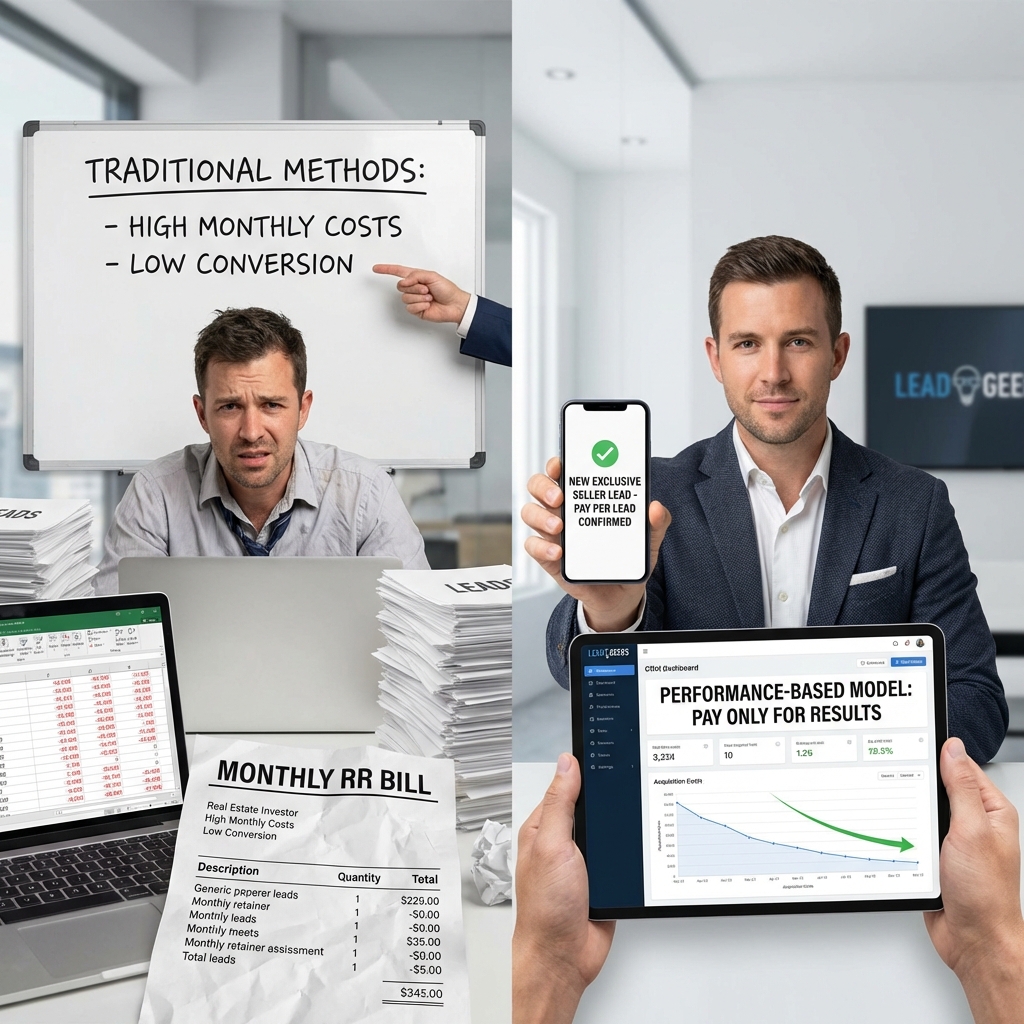
The secondary benefit is cash flow flexibility. Imagine needing to pause your marketing budget for two months while deals close. With traditional retainers, those two months still cost you money. With our model, you simply don’t request new leads and your costs drop to zero. When you’re ready to restart, you activate again immediately. No ramp-up period, no contract renegotiation.
A practical consideration: performance-based doesn’t mean we’re lenient on refunds. It means we stand behind lead quality. If a seller isn’t actually motivated or the contact data is bad, we own that failure. We’ll discuss our refund policy in detail below, but the key principle is clear: we’ve built our business on delivering leads you can actually work with.
How We Deliver Exclusive Motivated Seller Leads
Our lead sourcing strategy differs fundamentally from list-buying platforms. We’re not purchasing 10,000-contact databases and reselling thin slices to multiple investors. We source high-intent sellers directly through proprietary channels, then match them exclusively to investors whose criteria align precisely with their situation.
Our sourcing starts with identifying homeowners experiencing circumstances that create genuine motivation to sell quickly: job transitions, financial pressure, property maintenance issues, divorce situations, and inheritance complications. These aren’t speculative prospects. These are people actively considering a sale and timeline-sensitive about it.
We deliver these contacts as exclusive leads. If we send you a seller contact, we’re not simultaneously sending that same person to five other investors in your market. Exclusivity matters because it reduces your competition on that deal, shortens your negotiation window, and increases your probability of closing.
What kind of leads should I expect to get from LeadGeeks? We source across multiple channels: seller inquiries responding to specific marketing, direct outreach to homeowners meeting motivation criteria, and partnerships with professionals who encounter sellers in transition (attorneys, financial advisors, property managers). Each channel is vetted for lead quality before we ever pass contacts to you.
The exclusivity model requires us to be selective about volume. We’re not flooding the market with contacts because we can’t maintain quality if we’re selling the same seller to multiple investors. This scarcity is actually advantageous for you because it means less competition when you do receive a lead.
Data accuracy is built into our process, not added as an afterthought. Every lead comes with verified contact information, validated motivation factors, and recent timeline information. Your team shouldn’t need to spend an hour confirming basic facts before they can start a productive conversation with a seller.
Real-Time Lead Delivery and Immediate Action
Speed creates competitive advantage in real estate. The faster you contact a motivated seller, the faster you can understand their timeline and get an offer in front of them before another investor does.
We deliver leads via SMS and email the moment they enter our system. Not end of day. Not tomorrow morning. Real-time. You or your team gets an alert immediately, with lead details ready to review and act on. This means your SDR can be dialing the seller within minutes, not hours.
The real-time delivery model is only useful if the leads are actionable immediately. That’s why we include verified contact information and enough background detail that your team doesn’t need to do preliminary research before picking up the phone. You get their name, phone, property address, and motivation summary. Call them directly.
Integration with your CRM system means these leads land in your existing workflow automatically, which we’ll cover in the next section. But the immediacy of SMS and email notifications ensures you never miss a window. Even if your CRM is updated on a slight delay, you’re getting the alert the moment we receive the lead.
For teams coordinating across multiple people, real-time delivery prevents the classic problem where a lead sits uncontacted for two days because no one realized it had arrived. The notification goes to the person responsible for outreach, with all necessary details to initiate contact immediately. What to do next: confirm your SMS and email settings are pushing notifications to the right people on your team so that the real-time advantage isn’t lost due to notification fatigue or misconfiguration.
Integration with Your Existing CRM Systems
Your CRM system is the operational backbone of your real estate business. We’ve built integrations with the major platforms used by investors and agents so that leads we deliver slot directly into your existing workflow without manual data entry or parallel systems.
We support seamless integration with industry-standard platforms. Leads arrive in your CRM immediately, with fields properly mapped to your database structure. Your team doesn’t need to re-enter contact information or motivation details. They see the lead in their daily workflow exactly as they’d see any other prospect, with all the context needed to prioritize and assign.

The integration also means our leads sit alongside your other prospects, deals, and follow-up sequences in one place. Your agent or investor can see in seconds whether they’ve already contacted this seller through another channel, preventing duplicate outreach. That’s a quality-control benefit that saves time and preserves your reputation.
Reporting is cleaner with CRM integration. You can track conversion rates from our leads directly in your system, compare our lead source performance to your other channels, and identify which properties, neighborhoods, or seller motivations convert best for your business. That data helps you refine your acquisition strategy over time.
For larger teams managing multiple agents or SDRs, CRM integration prevents leads from slipping through cracks due to communication gaps. Lead assignment happens automatically if you’ve configured it, and everyone sees lead status in real time. Your action item: audit your current CRM system and confirm which platforms we support, then ensure your LeadGeeks account is configured for the integration. Many teams set this up and then realize weeks later they hadn’t actually activated automatic lead sync.
Eliminating Risk with Our Flexible Refund Policy
Here’s where performance-based pricing becomes concrete: if we send you a lead that doesn’t match what we promised, you can request a refund. No arguments, no defensive language, no contract clauses making it difficult.
Our refund policy recognizes that “lead quality” can be subjective if defined loosely, so we’re specific. If a seller we sent you isn’t actually motivated to sell in a reasonable timeframe, we’ll refund you. If contact information is inaccurate and you can’t reach them, that’s a refund. If the property doesn’t match the location or characteristics we indicated, that’s on us.
What we don’t refund is your own follow-up strategy or market conditions. If you contact a motivated seller and they change their mind two weeks later, that’s market reality, not our failure. If you call someone and they don’t answer, that’s not a bad lead, that’s contact timing. We refund bad data and false motivation signals, not bad outcomes from good leads.
The refund policy is simple because we’ve designed our sourcing to minimize refund requests in the first place. We’re not incentivized to argue about edge cases because our business model succeeds when we send leads you keep. Easier to just refund and move forward. This approach builds trust quickly with experienced investors who’ve been burned by other vendors defending poor quality.
We process refund requests within 48 hours. You request a refund, we verify the claim briefly, and we credit your account. No lengthy appeals process. No requirement to prove you called the seller. We assume good faith because you’ve proven it by working with us consistently.
For investors evaluating us, the refund policy is a good proxy for how confident we are in quality. Companies afraid of refunds usually have quality problems they’re defending. We welcome refund requests because they’re rare and they help us identify any sourcing issues we need to address. Your step forward: when you get your first few leads from us, track which ones convert and which don’t, then review whether any met our refund criteria. That data informs whether this model is working for your specific business.
Calculating Your True Cost Savings Per Deal
Let’s put numbers to the concept of performance-based pricing and see how it affects your unit economics.
Assume you work with a traditional lead provider charging $1,500 monthly and you receive roughly 40 leads per month. Your monthly cost per lead is $37.50. Now assume your conversion rate is typical for cold outreach: roughly 3% of leads become actual conversations, and roughly 10% of conversations become submitted offers. That means you submit an offer on about 1.2 deals per 40 leads. Your cost per offer submitted is roughly $1,250. Your cost per deal closed is higher still if your offer acceptance rate is 60%, landing you around $2,080 cost per closed deal.
Now let’s model our performance-based approach. Assume you pay an average of $80 per lead because we’re sending significantly higher-quality prospects. You still receive roughly 40 leads monthly. Your total monthly cost is $3,200, which seems higher until you factor in conversion rate. Our leads are exclusive and pre-qualified for motivation, so your conversation rate jumps to 35% and your offer submission rate climbs to 60%. Suddenly from 40 leads you’re submitting offers on roughly 8 deals monthly. Your cost per offer submitted drops to $400. At the same 60% acceptance rate, your cost per closed deal is around $670.
That’s a 68% reduction in cost per acquisition. You’re paying more per lead but dramatically fewer leads are needed to generate offers and closes. The math shifts further in your favor if your acceptance rate on offers is higher (which it often is with motivated sellers versus cold lists).
Of course, your specific numbers depend on your market, your offer strategy, and your ability to execute quickly on leads. But the principle holds for experienced investors: higher-quality, exclusive leads generate dramatically better unit economics than volume-based traditional sources, even when the per-lead cost appears higher on the surface.
Run the math for your current situation. Track where your deals actually came from over the past 6 months, calculate your true cost per acquisition by channel, then model what these numbers would look like with a higher-quality, lower-volume source. Most investors find that performance-based models outperform traditional retainers by a factor of 2x to 4x on cost per acquisition.
Scaling Your Business Without Fixed Overhead

One of the underrated advantages of performance-based pricing emerges when you think about business scaling. Fixed monthly costs don’t scale with your success, which sounds good until you realize it means you’re paying the same amount whether you’re acquiring 5 deals monthly or 15.
With traditional retainers, scaling is financially inefficient. You double your deal volume but you pay double for lead generation, yet your fixed costs shouldn’t increase proportionally if your lead source simply delivered better quality. Performance-based models align your expense with your output. More deals means more leads requested and more leads paid for, but you’re not pre-paying for capacity you don’t use.
This structure is especially valuable for investors planning geographic expansion. If you want to test a new market, traditional models require committing to expensive monthly contracts in that new area immediately. With our model, you request leads in the new market and pay only for what you use while you validate the market opportunity. If it works, you scale. If it doesn’t, you’ve minimized your sunk cost.
Seasonality becomes manageable too. Most real estate markets have slower quarters and busier quarters. With fixed retainers, your October lead cost is identical to your April lead cost regardless of market activity. With our model, you control volume seasonally. Slow quarter? Request fewer leads. Busy season? Request more. Your expense adjusts naturally.
For teams managing growth, this matters because it means you’re not locked into paying for lead generation capacity that matches your peak season if you’re building throughout the year. You can grow your acquisition team, prove it’s productive with our leads, then expand the lead volume as the team scales. It’s capital-efficient growth.
Success Stories from Our Seasoned Investor Partners
Our experience working with experienced real estate professionals across multiple markets has taught us what works. We’ve seen investors dramatically improve their deal flow and unit economics by shifting from traditional lead sources to performance-based approaches.
One investor we work with in the Denver market was paying $1,500 monthly to a traditional lead provider while closing 3-4 deals monthly. After switching to us and optimizing their outreach process around our higher-quality, exclusive leads, they closed 10-12 deals monthly within six months. Their lead cost increased from $1,500 to roughly $6,400 monthly, but their cost per acquisition dropped by more than 60% and their actual deal volume nearly tripled.
Another partner managing a team of three agents across Phoenix was dealing with duplicative lead overlap from multiple sources, creating confusion in their CRM and wasted follow-up. They consolidated to our leads exclusively, eliminated duplicate contacts, and reduced the time their SDR spent managing leads rather than contacting them. Same geographic market, same team size, but 40% more productive because the leads required less pre-qualification work.
A third investor told us that the exclusive nature of our leads changed how they could structure their initial offers. Because they knew another investor hadn’t already made an offer to the same seller, they could focus on building a genuine relationship rather than racing against the clock. That shift in dynamic led to better negotiations, more seller flexibility, and higher offer acceptance rates.
These outcomes aren’t anomalies. We see them repeatedly because our model is built for what experienced investors actually need: fewer, better leads that convert at higher rates, without monthly overhead creating financial drag.
Getting Started with LeadGeeks Today
Starting with LeadGeeks is straightforward because we’ve removed the friction that traditional lead sources create.
First, contact our team and describe your acquisition criteria: the markets you focus on, the property types and price ranges you target, and the seller motivations that work best for your business. We’ll explain what types of leads we can source in your specific market and what price per lead makes sense for your deal flow.
Next, we’ll set up your CRM integration if you’re using one of our supported platforms. This usually takes less than an hour and requires a single authentication step. Once integrated, leads will flow directly into your existing workflow with zero manual data entry required.
Then you’re ready to start receiving leads. You don’t pay anything upfront. You only pay per lead delivered, and you can start with small volume to test our quality before committing to larger monthly flow. This gives you the ability to calculate your actual conversion rate and ROI before you scale the relationship.
As you work with leads, we monitor feedback. If you’re requesting refunds on specific lead characteristics, we adjust sourcing. If certain neighborhoods or seller profiles convert better for you, we prioritize those. The performance-based relationship means we’re constantly optimizing based on what’s actually working for your business.
Your next step is simple: visit our site or reach out directly with your acquisition criteria and we’ll explain specifically what we can deliver in your market and at what price. No long conversations, no pressure, no multi-year contracts. Just a direct conversation about whether our model fits your business. That’s how we work.
For further reading: Lead types from LeadGeeks.