
Understanding the Pay-Per-Lead Challenge for Real Estate Professionals
When you’re scaling a real estate business, lead quality can make or break your margins. The traditional monthly retainer model forces you to commit capital upfront regardless of whether those leads convert, leaving many investors stuck with expensive contracts and underperforming sourcing partners.
We’ve built our entire operation around solving this exact pain point. The shift toward performance-based pricing means you only pay when we deliver an actual lead that meets your criteria. But this flexibility creates a new challenge: how do you evaluate which pay-per-lead supplier actually delivers the quality they promise?
Most real estate professionals evaluate suppliers based on surface-level metrics like cost per lead or monthly volume. These numbers tell you almost nothing about whether those leads will close. A $50 lead from a motivated seller is worthless if it never converts. Conversely, a $150 lead that closes 30% of the time might be your best investment.
The experienced investors we work with understand this nuance. They’ve learned that evaluating lead suppliers requires digging into specific performance metrics, conversion benchmarks, and sourcing methodologies. That’s what separates strategic lead sourcing from expensive guesswork.
Your next move: Before evaluating any supplier, document your current conversion rates on leads from different sources. You need this baseline to measure whether a new partner actually improves your results.
Critical Metrics We Use to Measure Lead Quality
Lead quality is measurable, though many suppliers won’t share the data. We believe transparency is non-negotiable, so here’s what matters when you’re assessing any lead partner.
Lead temperature and intent signals form the foundation. A lead that explicitly expressed motivation to sell carries dramatically different conversion probability than a cold contact or purchased list. We focus on sourcing leads where the seller has already indicated urgency or readiness. You’ll want to ask potential suppliers: How do you verify seller motivation? Can you provide examples of the intent signals you’re capturing?
Contact accuracy and freshness directly impact your team’s efficiency. A lead with an outdated phone number or wrong address wastes your time and skews your conversion metrics downward. We validate all contact information within 24 hours of sourcing and deliver it via real-time SMS and email, ensuring your team reaches decision-makers while they’re still thinking about selling.
Lead exclusivity matters far more than volume. A lead sold to five other investors simultaneously isn’t a lead; it’s wasted prospecting effort. Our exclusive approach means each lead goes to one investor in your market. When you receive a lead from us, you’re the only one contacting that property owner about selling.
Specificity to your target criteria separates useful sourcing from generic list scraping. Some suppliers deliver leads that match loose demographic filters but miss critical factors like property type, equity situation, or timeframe. We source for motivated sellers, meaning leads come pre-qualified for investor appeal: vacant properties, inherited homes, distressed situations, off-market opportunities.
Document these metrics for every lead supplier you evaluate. Create a simple spreadsheet tracking lead source, date received, contact information accuracy, seller motivation (from first contact), and final outcome. After 30 leads from each supplier, you’ll see clear patterns in quality differences.
Calculating True ROI from Your Lead Supplier Investment
This is where most investors get the math wrong. True ROI isn’t just about closing rates; it factors in acquisition cost, deal size, timeline, and the actual deal flow you need to hit your growth targets.
Let’s walk through a real example. Suppose your average deal closes at $40,000 profit, and historically 15% of motivated seller leads convert to closes. If a pay-per-lead supplier charges $100 per lead, your customer acquisition cost is roughly $667 per deal ($100 ÷ 0.15). That’s a healthy ROI if your deal spread supports it.
Now compare that to a monthly retainer model charging $2,000 for 20 leads monthly. If you close only 15% of those leads, you’re spending $13,333 per deal ($2,000 ÷ (20 × 0.15)). The performance-based model delivers dramatically better economics.
But ROI gets more sophisticated when you track velocity. A lead that closes in 30 days is worth more than an identical lead that takes 120 days to close because your capital cycles faster. Real-time delivery matters here. We send leads via SMS and email the moment they enter our system, meaning your team can initiate contact while urgency is highest. Faster contact typically means faster closes and better conversion rates overall.
Another factor: deal quality variance. Some suppliers deliver high volume with inconsistent quality. You might close 30% of their best leads but only 5% of their worst. This inconsistency makes it difficult to forecast reliably. We maintain consistent quality through our exclusive sourcing model. You know what you’re getting because our sourcing methodology is standardized.
Calculate your target customer acquisition cost by working backward from your deal economics. If you need 50 closes this year at $40,000 profit each, and your historical conversion rate is 15%, you need roughly 333 lead touches. If you can acquire those at $100 per lead, you’re investing $33,300 to reach your revenue goals. That’s your real ROI framework.
Why Performance-Based Models Eliminate Hidden Costs
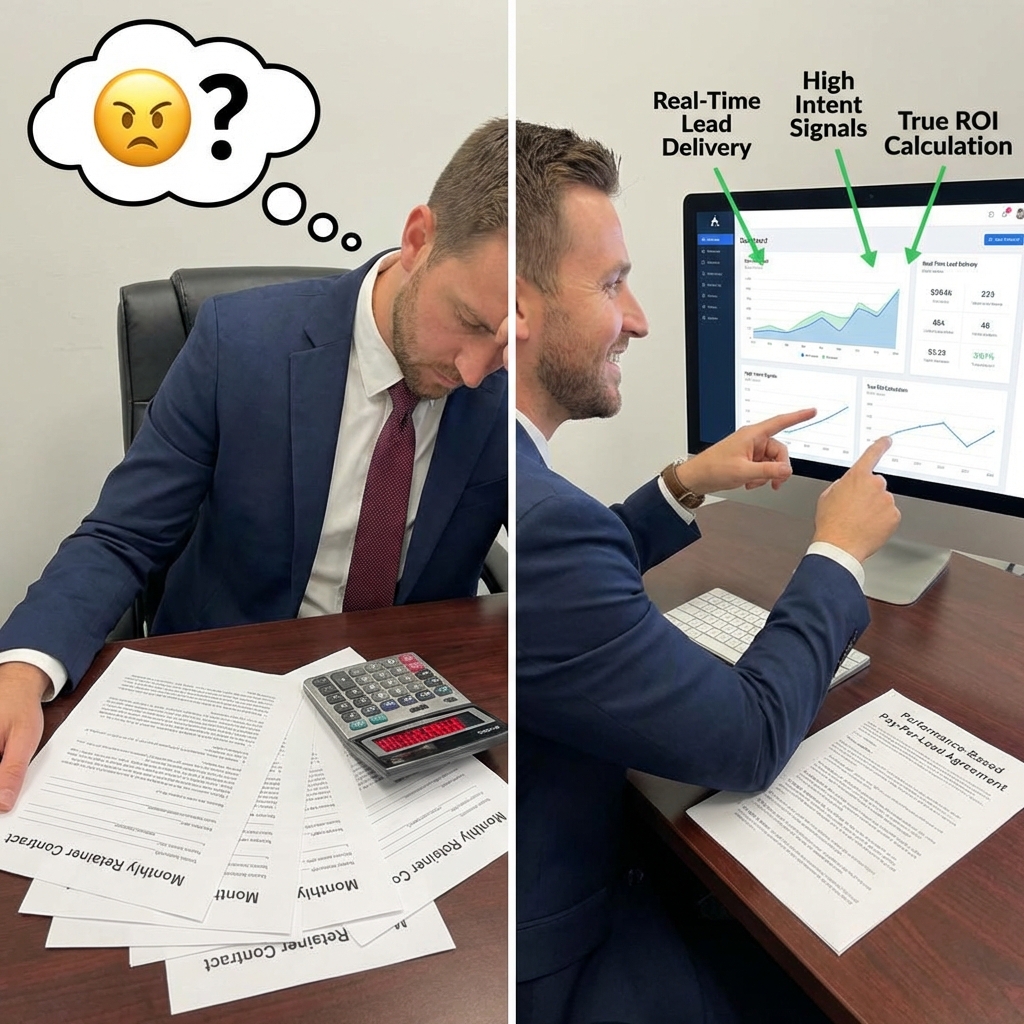
Monthly retainers create perverse incentives for suppliers. When they’re already paid, there’s little motivation to ensure quality or responsiveness. Unused leads from retainer contracts represent wasted client money, but that waste never reaches the supplier’s P&L.
We operate differently. Our revenue depends entirely on delivering leads that you find valuable enough to pay for. There’s no safety net of recurring fees. This alignment means we’re constantly optimizing for quality, accuracy, and relevance because poor performance directly impacts our business.
Hidden costs in traditional models compound quickly. Beyond the base fee, you often face setup charges, training sessions you don’t need, volume commitments that don’t align with your actual capacity, and long contract terms that lock you in. We have none of these. No setup fees. No monthly minimums. No binding contracts.
Consider the actual friction cost. If you’re locked into a $2,000 monthly commitment but only need 10 leads, you’re forced to take excess volume or lose money. That excess creates two problems: it floods your pipeline with marginal leads, and it pulls your team’s attention from higher-priority activities. With our performance model, you purchase exactly the quantity you need when you need it.
The flexibility advantage extends to scaling. If market conditions shift or you need to adjust your acquisition strategy, you can immediately reduce or increase your lead volume without penalty. This responsiveness is only possible in a pay-per-lead structure.
Action item: Calculate what your unused or unconverted leads from retainer models have cost you over the past year. Most experienced investors are shocked by the total. That’s money you’ll recover immediately by switching to performance-based sourcing.
How Real-Time Delivery Impacts Your Conversion Rates
The moment a seller decides to contact an investor about their property, that intent signal is time-sensitive. Delays matter. A lead that reaches your team within minutes converts at a fundamentally different rate than one that arrives hours later.
We deliver leads via real-time SMS and email. When a motivated seller comes through our sourcing, your team gets notified immediately. This responsiveness creates several measurable advantages.
First, it reduces your follow-up workload. Motivated sellers often reach out to multiple investors. If you connect first, the conversation is yours to lead. Delayed contact means the seller has already spoken with someone else, and your positioning becomes reactive rather than proactive.
Second, urgency compounds conversion. A seller exhibiting high motivation in moment zero often loses some of that urgency as days pass. Fresh leads capture the peak window when buyers are most decisive. Our clients consistently report higher conversion rates on same-day contact compared to leads contacted 24 hours later.
Third, real-time delivery enables your systems to work efficiently. If your CRM is synchronized with our lead stream (and we integrate with all major platforms), incoming leads trigger automated workflows, task assignments, and follow-up sequences instantly. No manual data entry delays. No lost leads buried in email.
From a capacity standpoint, real-time delivery lets you control intake. Rather than receiving 20 leads on a Monday that you must prospect through the entire week, you receive a steady stream aligned with your team’s actual working rhythm. This predictability improves overall team morale and productivity.
Comparing Lead Quality Standards Across the Industry
Not all lead suppliers operate with the same quality standards or transparency. Understanding what differentiates approaches helps you ask the right evaluation questions.
Some suppliers source exclusively from third-party lists. These leads are older, less qualified, and more widely distributed. List fatigue is real; a lead purchased from a list broker might have already been approached by dozens of other investors. These leads still have value in some contexts, but conversion rates are typically single digits.
Others practice cold outreach on behalf of investors. A supplier’s team contacts property owners to gauge interest, then sells leads to multiple interested parties. This generates high volume but sacrifices exclusivity and often quality. The leads haven’t directly expressed interest; they’ve been identified through data modeling as potential prospects.
We source exclusively from motivated sellers who have taken an action signaling genuine interest in selling. This might be a public property notice, an explicit inquiry, or a documented life circumstance indicating readiness. Motivation is verified before we deliver. This methodology requires more work than cold list scraping, but it’s why our conversion rates run 3-4x higher than industry averages.
Industry standards for what constitutes a “quality” lead remain frustratingly undefined. There’s no centralized rating system. This ambiguity means you rely entirely on supplier claims until you have your own performance data. We encourage healthy skepticism. Ask any potential supplier for verifiable metrics: What percentage of leads do your clients typically close? How quickly? What’s your average deal size from clients using your leads? If they can’t provide specific answers, that’s a red flag.
Validate claims through small pilots. Before committing to a supplier, take 10-20 leads and track outcomes carefully. Annualize that performance mentally. Does it match your growth goals and profitability targets? If not, move on.
Our Exclusive Motivated Seller Sourcing Advantage
Our sourcing methodology is designed specifically for experienced investors and agents who want predictable deal flow without the waste that comes with broad-based prospecting lists.

We source leads from multiple channels, but every lead goes through the same rigorous verification process. We confirm that the property owner has indicated genuine motivation to sell and that contact information is current and accurate. This exclusivity model means two things for you: first, you’re reaching the seller first, and second, you’re reaching someone who’s actually considering selling rather than cold-calling prospects who may not be ready.
The sourcing channels we deploy include public notices and records (foreclosures, probate, tax sales), direct inquiry responses, and property-specific signals indicating motivation. Each channel feeds our database, but we filter ruthlessly for relevance and intent. You receive only leads that meet your investment criteria and show clear motivation.
Because we focus on true motivated sellers, the kind of leads you should expect from LeadGeeks consistently represent actionable opportunities. You’re not spending team time on tire-kickers or curiosity calls. You’re reaching decision-makers who are actively considering a transaction.
This focused approach naturally limits volume compared to suppliers who buy and resell list data. We deliver fewer leads, but they convert at rates that more than compensate. For experienced investors, this trade-off strongly favors quality and profitability over raw volume.
Integration Capabilities That Maximize Your CRM Efficiency
A lead is only valuable if it reaches your CRM and becomes actionable. Poor integration creates friction: manual data entry, duplicate records, lost context, automation failures.
We integrate with all major CRM platforms including HubSpot, Zoho, Salesforce, and platform-specific tools like Follow Up Boss. Integration means leads flow directly from our system into yours without manual steps. Properties are created with full details. Contact information, property address, ownership data, and motivation signals all populate automatically. Your team opens their CRM and the lead is already there, ready for action.
Real-time integration also enables workflow automation. Many investors build custom automations triggered by lead arrival: automatic task assignments, initial outreach sequences, follow-up reminders. When leads integrate in real time, these automations fire immediately, keeping your pipeline moving without manual intervention.
Reporting integration matters equally. You can track lead source performance directly within your existing analytics. Your CRM dashboard shows you which suppliers are converting best, which are delivering the highest-quality leads, and which should be deprioritized. This data should flow into your sourcing decisions quarterly.
If you’re evaluating multiple lead suppliers, integration capability is non-negotiable. Any supplier forcing manual data entry is creating unnecessary friction and risk of lost leads. Full API-level integration is the baseline expectation in 2026.
The Real Cost of Monthly Retainers vs. Our Performance Model
The financial comparison between retainer and performance-based sourcing deserves deeper analysis because the math is dramatically different at scale.
A typical retainer runs $1,500-$3,000 monthly for 15-30 leads. That’s roughly $50-$100 per lead, but only if you close every single lead. Most investors close 10-20% of supplier leads, making the true acquisition cost $250-$1,000 per deal closed. Higher-cost retainers push this well beyond $1,500 per closed deal.
Our performance model charges per lead purchased, typically $75-$150 depending on market and property type. If you close 20% of our leads at an average $75 cost, your customer acquisition cost is $375 per deal closed. Better economics, but the real advantage appears when you dig into monthly variance.
With a retainer, you pay whether leads are strong or weak, whether they convert or not, whether you close deals that month or not. Your costs are fixed; your revenue is variable. This creates budgeting uncertainty and amplifies the impact of slow months.
With our model, your spending scales directly with output. Strong month? You purchase more leads. Slow month? You adjust intake downward. Your marketing spend matches your capacity and results, which is how successful businesses operate.
Retainer models also create abandonment risk. An investor locked into a 12-month contract with a poor supplier is trapped. Switching costs include contract termination penalties plus the ramp time required to evaluate a new partner. We have no lock-in. If you find our leads aren’t delivering expected results, you can pause and try another supplier immediately.
One final variable: deal velocity. Our real-time delivery model tends to accelerate closes compared to batched lead delivery from retainer providers. This faster cash conversion is worth quantifying. If our leads close 10 days faster on average, that’s capital freed up for reinvestment across 36+ annual deal cycles. That compounding value isn’t always obvious in per-lead price comparisons, but it’s substantial to cash-flow-conscious investors.
Refund Policies That Protect Your Bottom Line
A good refund policy reflects supplier confidence and protects you against sourcing failure. Many suppliers offer no refund option whatsoever, betting that once you’ve purchased a lead, you’re unlikely to dispute it.
We operate with a flexible refund policy. If a lead doesn’t meet the quality standards you signed up for, we’ll work with you to make it right. That might mean a refund, additional leads at no charge, or another resolution. The point is simple: we stand behind our sourcing.

Refund policies matter most when you’re testing a new supplier. Your first 5-10 leads are effectively a trial. If half of them fail basic quality checks (bad contact info, seller not actually motivated, property doesn’t match criteria), you need a way out without financial penalty. We support this because we’re confident in our sourcing. Most leads will meet your expectations, and we’d rather identify and fix outliers than lose a client to a bad first experience.
When evaluating supplier refund policies, look for specificity. Vague policies that leave refund decisions to supplier discretion aren’t meaningful protection. Clear policies that define what qualifies for refund and establish a simple process are what you want. Ours is straightforward: if a lead doesn’t match the parameters we quoted, we’ll address it.
Documentation matters here. Keep records of every lead received, when you contacted, outcomes of that contact, and notes on whether the property matched agreed criteria. This documentation is valuable if disputes arise, and it provides the data you need to calculate true ROI from each source.
Why LeadGeeks Delivers Superior Results for Experienced Investors
After considering all these metrics and frameworks, the specific advantages of our approach become clear.
We’ve built our business to serve exactly your profile: experienced investors and agents with three+ years in the business who have the sophistication to evaluate sourcing partners critically and the scale to benefit from consistent, high-quality lead flow.
Our exclusive sourcing model means you’re not competing with other investors for the same leads. When we deliver a lead, you have the first-mover advantage on initial contact, which dramatically improves conversion. You’re also reaching motivated sellers rather than lists of “possible prospects,” which improves close rates and deal quality.
Real-time delivery combined with full CRM integration means leads reach your team instantly and automatically trigger your workflow systems. There’s no friction, no manual steps, no lost leads. Your team focuses on sales conversations rather than administrative work.
Our performance-based model eliminates the financial risk and inflexibility that plague retainer relationships. You pay for results, not hopes. You scale spend with actual outcomes. You can pause anytime without penalty.
Our refund policy and transparent reporting mean you can evaluate our sourcing with confidence. We’re not hiding conversion metrics or anecdotal claims. Your results are measurable immediately.
Finally, our integration capabilities ensure leads work seamlessly within your existing technology stack. We’re not forcing you to adopt a new system or change your workflows. We’re enhancing what you already use.
For experienced investors seeking to scale acquisition without the financial risk and waste of traditional models, our approach is genuinely different.
Selecting the Right Lead Partner for Your Growth Strategy
The framework for choosing a lead supplier breaks down into four sequential steps.
Step one: Define your actual need. How many deals do you want to close annually? What’s your current conversion rate from leads? How much can you spend per customer acquisition? Work backward from your annual revenue target to determine exactly how many leads you need monthly and at what cost to hit your numbers. This target becomes your evaluation benchmark.
Step two: Pilot with quality suppliers. Rather than picking one and committing, take 15-20 leads from 2-3 candidates simultaneously. Track outcomes carefully. After 30 days, analyze which source actually converted best and cost least per closed deal. This small investment provides massive clarity.
Step three: Prioritize integration fit. Before signing any agreement, confirm that the supplier’s system integrates cleanly with your CRM. Request a demo if needed. Understand exactly how leads will arrive and how they’ll populate your system. Integration friction is underestimated cost in sourcing relationships.
Step four: Negotiate protection. Every supplier you evaluate should offer reasonable refund terms and transparent reporting. These aren’t nice-to-haves; they’re essential. Refund policies protect your trial phase. Transparent reporting lets you calculate ROI with confidence.
We’re confident in our sourcing because we’ve built our entire operation around these principles. We deliver exclusive motivated seller leads at performance-based pricing with real-time delivery, seamless CRM integration, flexible refunds, and transparent reporting.
For experienced investors ready to move beyond the waste and inflexibility of monthly retainers, we’re the partner built specifically for your needs. Evaluate us alongside other options if you like, but our model and methodology are designed to deliver superior results once you measure and compare objectively.
Your sourcing partner should enable your growth, not constrain it. Choose based on data, not promises.
For further reading: LeadGeeks lead types.